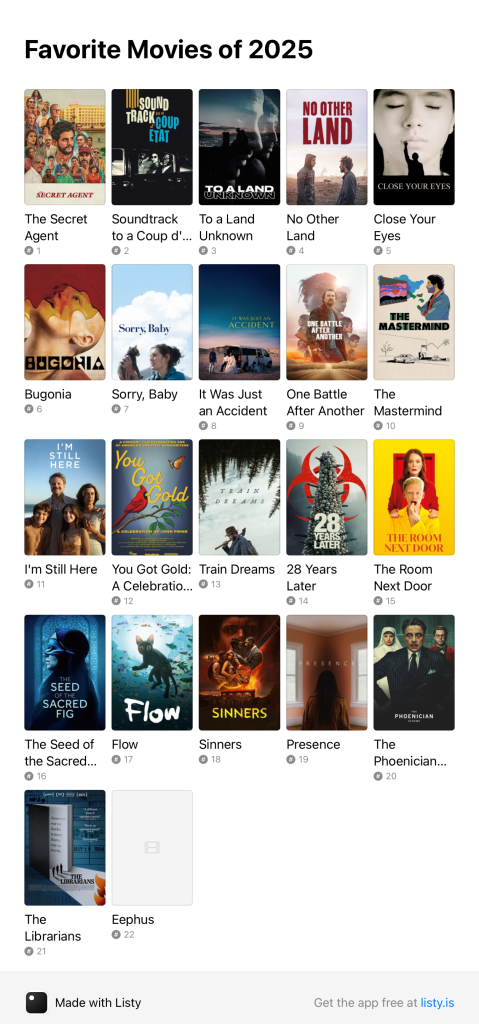
My annual favorites list is posted here as part of my yearly ritual. What has stood out for the past several years is how many of my favorite films are made outside of the United States and/or by foreign directors. The films that topped my list this year were by Brazilian, Belgian, Palestinian-Danish, Spainard, Palestinian, Israeli and Greek directors. These were also the best political films that I saw in 2025. This raises some larger questions that I will start examining in this post, but will continue as part of a series of posts devoted to the politics of film.
My top six films: The Secret Agent, Soundtrack to a Coup d’ Etat, To a Land Unknown, Close Your Eyes, No Other Land, and Bugonia, were all committed to large-scale canvases which interrogated big themes of history, memory, the cost and consequences of power, and characters whose search for meaning and survival is tied to a broader engagement with society. In short, for me, the best political films have a societal and historical perspective. They are not centered on individuals, or if they are, they locate individuals within a broader societal context. The way directors and screenwriters frame images and words on the screen often reflects judgments that are inherently political. What distinguishes the top six films on my list is that they all have a strong sense of place that is grounded in social interaction and a profound interrogation of the way that circumstances are the product of choices constrained by power and by time.
The film that topped my list, The Secret Agent, is directed by Brazilian filmmaker Kleber Mendonca Filho. Of all my favorite films this year, The Secret Agent operates on the most expansive political canvas, incorporating fully all the elements I have previously listed as characterizing the best political films. The Secret Agent traces the saga of the protagonist, widower Armando (Wagner Moura), as he returns to his hometown of Recife to reunite with his young son. Set in 1977, the film teems with vivid images of working class Brazil in the midst of a military dictatorship. The viewer is immersed from the outset in seeing Recife from the eyes of Armando, a political dissident who had been forced to flee Brazil after his confrontation with a businessman whose wealth and power are closely tied to the repressive apparatus of the Brazilian state. Within this outline of power, repression and defiance, the director frames historical memory and societal power structures within the lived experiences of Brazilian communities. The viewer is immersed in collective networks of working class dissidents whose own histories are conveyed through their interactions with Armando.The shared experiences of these communities are powerfully brought to life by a wonderful array of characters and personalities—the film has an Altmanesque flavor in capturing both society and place though idiosyncratic characters. There is also a strong sense of historical memory through references to movies as a shared experience of remembering, from the fact that Armando’s father-in-law works at a local cinema in Recife at the time of Armando’s return, continuing through the memory of Armando’s son having seen Jaws at that local theatre, and from the use of myth and metaphor when a man eaten by a shark becoming a mythical one-legged creature who haunts Recife and engages in grisly murders.
The best aspects of political cinema are represented by the directorial choices in The Secret Agent: a big canvas that incorporates history, a critical interrogation of power, and a societal context that is framed by the director in a way that challenges the viewer to understand and empathize with characters that have very little power and control, but are finding ways to fight back and preserve their humanity. These qualities were also present, in varying degrees, among my other favorite films of the year. Soundtrack to a Coup d’ Etat, directed by Johan Grimonprez, uses documentary footage with only a jazz soundtrack, no voiceover narration, to tell the story of how the forces of imperial power, through the U.S. and the United Nations, conspired, often with the unwitting assistance of jazz artists who were deployed as CIA-funded U.S. “ambassadors” to the Congo, in the 1961 assassination of democratically elected President Patrice Lumumba. The genius of the film lies in its powerful cinematic editing of both documentary images of events as they were unfolding in real time, combined with how the political attacks on Lumumba had escalated as part of a broader war between colonial powers and decolonial liberation movements, the U.S. and Soviet Union, and within the context of divisions within the cultural and jazz worlds during the time the assassination was being plotted, with several jazz artists protesting the vilification of Lumumba at U.N. meetings prior to his assassination. Director Johan Grimonperez manages to craft a political film that is grounded in the consequences and costs of imperial power, layered though striking visual images, and that movingly captures a struggle between opposing forces in the battle over the future of the Congo.
My third favorite film, To a Land Unknown, directed by Palestinian-Danish filmmaker Mahdi Fleifel, is more focused on narratives of individual survival in a specific time and place: Palestinian immigrants who have managed to migrate to Greece but whose undocumented status puts them in daily jeopardy, from state repression to underground networks who prey on immigrant vulnerability. This film, unlike the first two, has a tighter directorial framing, less expansive and more focused on the tight spaces the two lead characters have to navigate. The filmmaking, however, uses the close-ups and the engergies of the two lead actors and a strong supporting cast to direct the viewer toward identification with their plight and an understanding of why they made the choices they did. The larger structures of history, power, circumstances and survival among the most marginalized and oppressed, are given center stage here through a discerning and powerful directorial eye, with sharp dialogue that is believable and carefully developed.
Writer and director Victor Erice works on a very large canvas in the film Close Your Eyes, which explores the long mystery of what happened to an actor that mysteriously vanished from a movie in production. The film intersperses the distant past, when the film was being made, to the present, when the former director becomes immersed in an investigation of what happened long ago to one of his actors. The search for the truth takes the director through villages, memories of place, colorful personalities whose fortunes, or misfortunes, intersect with the director’s journey, and eventual reconnection with the film’s crew. Less overtly political than the first three films on my list, the extent to which the filmmaker captures an individual journey to connect him to his own community of creative artists and their shared memories, becomes a strong message of the intersection of art, memories, and community.
No Other Land is a harrowing cinematic portrayal of the deadly costs and consequences of the illegal Israeli settlements on the West Bank. As Israel has continued to militarize, police and dispossess Palestinians to the point of eviscerating any realistic hope for a “two-state” solution in the West Bank, this documentary emerges as a powerful testimonial to Palestinian resistance, suffering and daily degradation by Israeli settlers backed by the full repressive weight of the reactionary Israeli state. The Palestinian co-director, Hamdan Ballal, was attacked and assaulted by masked Israeli settlers outside his home while filming settler violence. After which, the Israeli military arrested and detained him before he was eventually released. Awdah Hathaleen, a Palestinian community leader who was a consultant for the film, died on July 30, 2025 after being shot by an Israeli settler. The politics of this film dared to challenge very powerful forces of Israeli settler colonialism and what we have left is more carnage in response to these and other efforts at collective resistance.
Bugonia is the sixth film on my list. Directed by Yorgos Lathimos, this film also operates on a large-scale political canvas. One of the lead characters is a conspiracy theorist whose alienation and loneliness is manifested in his conviction that he has discovered the source behind the degradation of ecosystems, specifically his bee population on the farm he inhabits, as well as the destruction of the environment and lives lost due to global contamination, including what he believes is the chemical contamination of his mother, resulting in her death. The target of his obsession is the CEO of a major company (he is convinced that she is a leader of an alien conspiracy), whom he and his friend kidnap and whom he subjects to torture to try to produce a confession from her of her responsibility for the impending destruction of the earth. What makes this film a heartfelt and passionate plea for human connection in the face of dire circumstances is the way that the main characters are portrayed: all are multi- dimensional and complex, including the conspiracy theorist, his much-abused and taken advantage of autistic friend, and the CEO of the company, whose history is exposed in a way that highlights corporate responsibility for environmental destruction. The ending is a harrowing worst case scenario that is both the product of science fiction imagination and the reality that potentially confronts humanity if we fail to address the threats before us. Urgent, compelling and underrated , this film continues the already great filmmaking of Lathimos on yet another large-scale and provocative canvas.
Another film with a powerful historical, social and political message that interrogates the brutality of an authoritarian regime is It Was Just an Accident, directed and written by Jafar Panahi, whose directorial career in and outside of Iran has been focused on a critical dissection of the oppressive rule of the Iranian dictatorship. This film puts front and center an Iranian victim of government torture whose attempts to enact revenge involve an elaborate capture of the suspected perpetrator, alongside help from fellow victims to figure out what to do with the suspected perpetrator. The tones shift from the darkly comical to the deadly serious repercussions of the oppressed trying to figure out what to do with and about their oppressors. A key question that is asked: how to avoid treating “them” just like they treated you.
The U.S. film that is closest in sensibility and large-scale cinematic scope to the top foreign films on my list is One Battle After Another, directed and written by Paul Thomas Anderson. This film may be Anderson’s most political film of his career, especially the riveting sequences of political solitary displayed by immigrant communities in Los Angeles as part of a political resistance to anti-immigrant raids and roundups being orchestrated by the political establishment, exemplified by a marriage of corporate power, profiteering and white supremacist leaders who cooperate to keep immigrants locked down and terrorized. The thread connecting these organized struggles against ICE-type attacks is an older historical figure who had been involved long ago in guerrilla tactics of organized violence against symbols and perpetrators of state and corporate repression. The ability to turn what seemed initially to be a cartoonish caricature of a fringe hippy into the centerpiece of a more collectively inspiring resistance to contemporary oppression is a testament to Anderson’s skill as a writer and a filmmaker. This film incorporates wildly different tones into its canvas in ways that come together by the end, which ultimately is an endorsement of social and political activism.
The exceptional Sorry Baby, directed, written and starred in by Eva Victor, is a haunting and emotionally powerful narrative of a woman victimized by sexual assault. Rather than focusing on the victimization as defining the central character, the filmmaker and writer delve into the evolving capacity of the victim to better understand and cope with the circumstances and aftermath of the assault. The fact that she is surrounded by friends and gains support for her situation in unlikely places, as well as her own ability to use humor to find pathos, resistance and healing, provide a wider context for understanding who she is as a person. This film is very focused on the story of the main character, but we are very much exposed to a wider lens in examining power relations and institutional sexism/misogyny.
Another U.S. film on my list is one that interrogates individualism by placing it at the lonely heart of U.S. culture. The film Mastermind, directed by the great Kelly Reichardt, focuses on the life of a suburban unemployed family man who decides to rob an art gallery as a project that seems designed to both alleviate boredom, provide a sense of purpose and elevate the wounded sensibility of the character. What transpires instead is a poorly executed and misfired plot to vandalize a local museum, with consequences that are dire and explosive in its affects on the man’s family, but also revealing in what the filmmaker has to say about how his acts of defiance reveal about a culture of individualism that refuses to care for others and even helps provide cover for large-scale collective atrocities such as the Vietnam War, images of which provide the background for the lead character’s unsuccessful attempt to hide from the world around him.
The much-hyped U.S. film that was a major disappointment for me, Marty Supreme, revels in an individualism that represents much of the worst of U.S. cinema. Unlike the previous Uncut Gems, co-directed by Josh Safdie (sole director of Marty Supreme), which located its central characters’ addiction to gambling within a larger ecosystem of profits and greed surrounding the cultivation and sale of rare minerals, Marty Supreme is almost entirely focused on the sports dream of its central character. Instead of giving the audience a more complex context of societal interaction with Marty that could allow us to understand the choices he has made for himself, the film surrounds an obnoxious Marty and his single-minded focus on global sports stardom (to be the best table tennis player in the world) with even more self- centered and obnoxious individuals whose crassness and barbarity make Marty look a little better only by comparison. There is also a sexism that runs through the movie: the women characters are primarily defined through their attraction to Marty, rather than being given any believable personalities of their own. Marty the individual striver is the message. And his individualism defines the film.
In fact, the perspective that the audience is confronted with in Marty Supreme is not society/ individual, but rather what kind of individualism is required given that every individual around you is greedy, selfish, hateful and uninspiring. There is no “society” here and certainly very little connection. Everyone is atomized to the point of contrivance. Marty, played by Timothy Chalamet, has a goal larger than everyone else who inhabits his rotten world. Just having a larger goal is a big part of where the film pivots. The entire film is focused on him trying to reach the goal. That means the film operates as a kind of highwire race to see how many situations and people Marty can navigate through, often with deadly consequences, to even get a (false) chance to realize his dream: which involves a rematch with the reigning Japanese world champ whom he lost to in an earlier tournament. The sports mythologies that this film traffics in are built around the individualism that the filmmakers pretend to question or mock, only to embrace the myth of a fallen hero who returns to the womb (of sorts) in a fanciful ending that leaves his character partially redeemed. It’s a crowd pleaser in a way that allows the director to avoid tough choices that Uncut Gems confronted. Its safety valve lies in its nihilistic rejection of anything resembling a society; we all have to save ourselves as individuals from the greediness we inhabit.

 View From Left Field