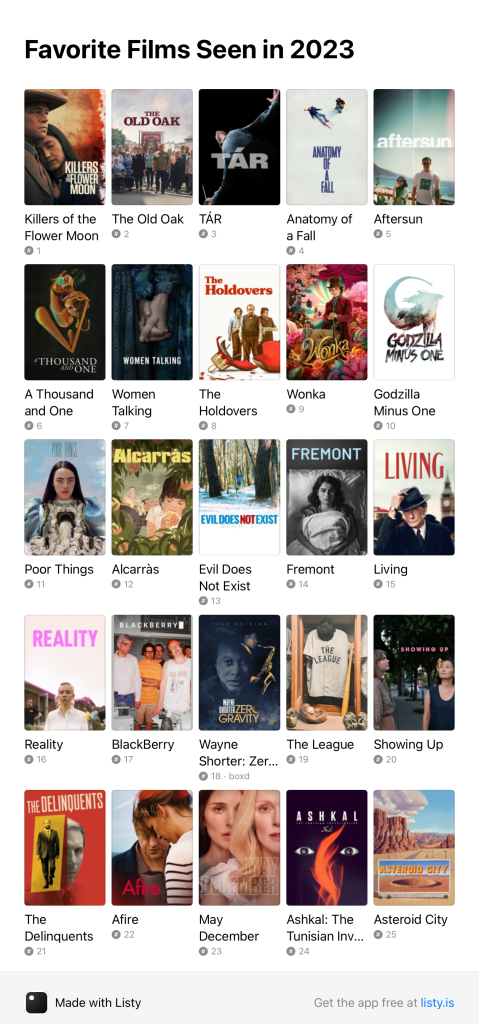
There were some great political films released last year, including my top two: Killers of the Flower Moon and The Old Oak. Killers is one of the classics of Martin Scorsese’s prodigious career, and Old Oak may be the last film in the career of Marxist director Ken Loach, whose work with screenwriter Paul Laverty has produced some of the great political films of all time, including his latest.
Scorsese’s film has an unrelenting intensity that closes in on the viewer. The conspirators, led by rich landowner William King Hale, played with chilling calculated brutality by Robert DeNiro, orchestrate a series of grisly murders to capture the wealth of targeted Osage families. The focus of the conspiracy is the marriage of Hale’s nephew, Ernest Burkhardt, played wonderfully by Leonardo DiCaprio, to an Osage woman, Mollie, played brilliantly by Lily Gladstone. Their marriage and relationship intersects the mass killing spree undertaken by whites to seize the wealth of the Osage. Powerfully developed to maximize the feeling of being witness to a slow-motion horror show.
Old Oak is set in a village in northern England inhabited by former miners whose lives were decimated by the defeat in the miners strike in Britain during the 1980s. The residue of that defeat gets translated in different ways by the villagers, as they encounter Syrian immigrants who arrive in town. One former mine worker, played beautifully by a non-professional actor, Dave Turner, who has had smaller roles in previous Loach films, decides to befriend the Syrians, only to suffer the blowback from his old friends, who want to blame immigrants for their problems. The ending is powerfully optimistic regarding the potential for forgiveness and solidarity.
The third film on my list, Tar, is by director and screenwriter Todd Field, who crafts a story about a famous musical conductor, Lydia Tar, that manages to tackle the relationship between power, fame and artistic achievement through a profile of the conductor herself. Cate Blanchett is brilliant in the lead role, showing the psychological depth and breadth of Tar’s rise and fall.
My fourth film, Anatomy of a Fall, is one of the most exceptional and psychologically complex explorations of a decaying marriage through the depiction of the aftermath of either a murder or suicide of the husband (the viewer is left to figure out which, in part through the mind and words of the couple’s son and through the riveting courtroom proceedings). The director and writer, Justine Triet, has a profound talent for writing realistic, complex and gripping dialogue, coupled with the skill of framing scenes to maximum effect, that produces a roller coaster ride of emotions that are well-earned. A true masterpiece.
The fifth and last film I rated a perfect five stars is Aftersun, directed and written by Charlotte Wells about the memories of a woman who recounts a bittersweet weekend spent with her dad, through photographs and moments that capture their special bond but also traces an emotional distance that would widen with a tragic end. This is a poignant, complex and deeply moving personal story that I’m still thinking about long after seeing the movie.
A Thousand and One is a well-crafted, emotionally intense narrative of a woman released from prison who takes a child that she claims as her own from foster care. The film has a depth and nuance which avoids cliches and stereotypical Hollywood endings. Teyana Taylor is amazing in the lead role, surrounded by a stellar cast and direction that succeeds in capturing the political economy of Harlem through the decade of the 1990s and early 2000s, when gentrification and stop and frisk policing operate as a stranglehold on impoverished communities. Brilliantly directed and written by A.V. Rockwell, whose perceptive, evocative sense of character and place is evident is the way she frames scenes between the main characters, allowing them to develop organically so that you get a real sense of the passage of time.
Here is a complete list, which includes some films made in 2022 which I saw this past year:
 View From Left Field